Friday, 26 August 2011

Wildlfe and history in Brockley and Ladywell Cemeteries

Brockley and Ladywell Cemetery
Like many other urban cemeteries, my local one - Brockley and Ladywell Cemeteries - is a haven for wildlife. Whilst there are some lovely parks nearby, these are all far more intensively used and managed whereas much of the cemetery is effectively wilderness with large trees and long grass. From the middle of it, you can barely see the surrounding housing and it's easy to forget you're in the heart of a built-up area.

Cemeteries also provide a great way of learning more about local history and whilst it's fun to wander round and speculate about the stories behind the various people buried there it's even better to do that with someone who actually knows some of those stories. Last Sunday I did just that on a guided walk organised by the Friends of Brockley and Ladywell Cemeteries. For a couple of hours, our knowledgeable guides provided about a dozen of us with some fascinating insights into some of the famous and not-so-famous people associated with the cemeteries. We also learnt that the two cemeteries - then called Deptford and Lewisham - were originally opened as completely separate plots but were then combined and renamed under the management of Lewisham Council.

Sir John Gilbert's grave
Those buried there include Sir John Gilbert, who produced numerous illustrations for Punch and the Illustrated London News and Queen Victoria's physician, Sir Alexander Nisbet. There are also a number of poets including the war poet, David Jones, and the 19th century poet, Ernest Christopher Dowson, whose grave was restored and rededicated last year. Others who have left their mark locally include the Jerrard family who were the builders responsible for several streets of housing in the area and whose name lives on in Jerrard Street off Loampit Vale.

Memorial to Jane Clouson
What is perhaps most moving are the stories of ordinary people remembered in various ways in the cemeteries. There is a particularly striking memorial to 17-year-old Jane Maria Clouson - 'a poor motherless girl' who was murdered in April 1871. Despite strong circumstantial evidence against him, the alleged perpetrator (the son of her employer) was acquitted and the public was so incensed at this outcome that they raised a subscription to erect a memorial for Jane.


The area's maritime links are reflected in the number of memorials to those lost at sea and the impact that both world wars had on the area is evident in the memorials to those killed locally as well as shrapnel damage to some of the memorials. A further insight into lesser known parts of local history was provided by the memorial to someone killed whilst riding 'a spirited horse' in the Deptford Carnival in May 2nd 1900 - evidence of the lively May Day celebrations that used to take place at that time.

Memorial with shrapnel damage

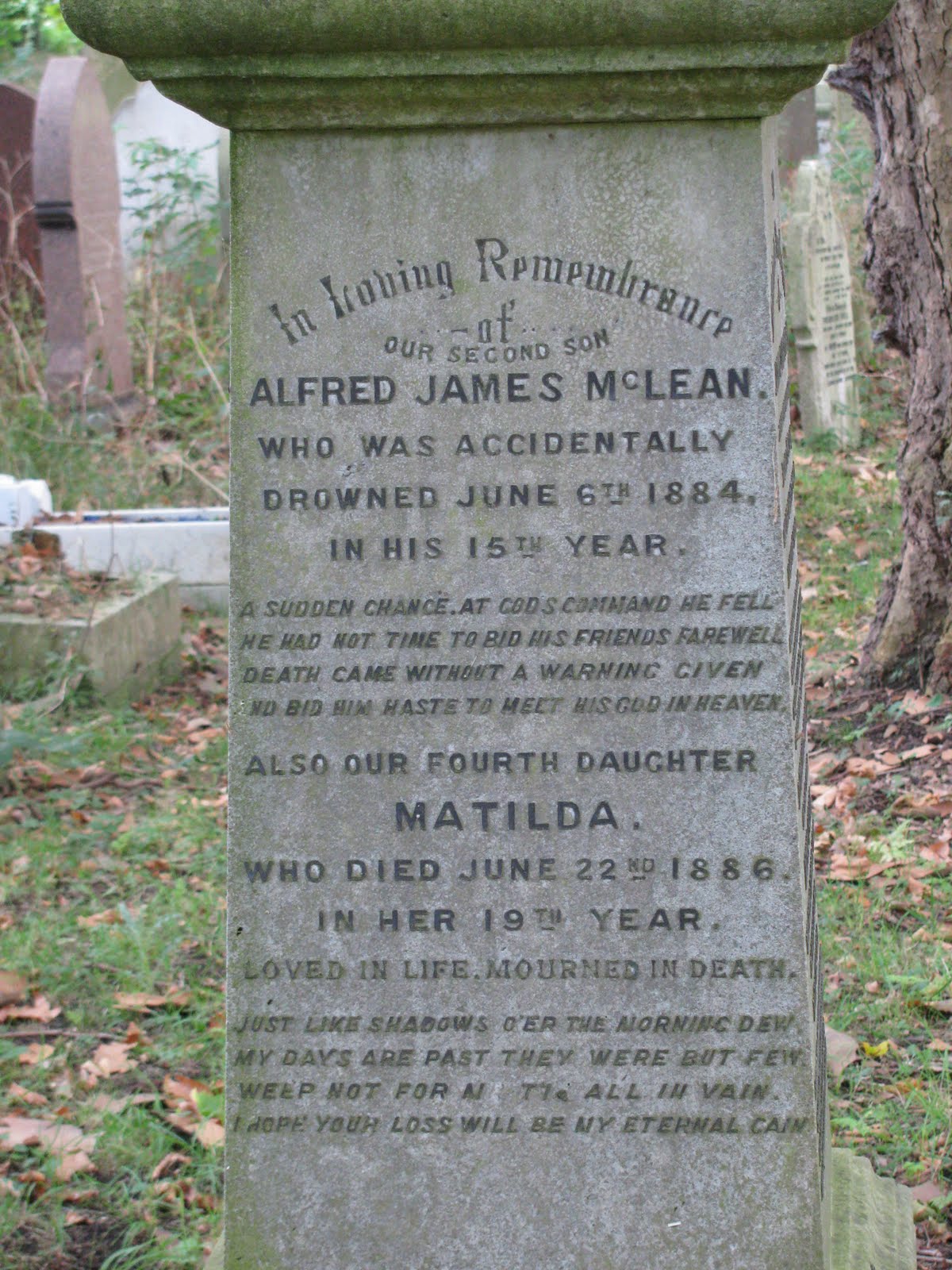
One of the many memorials to those who drowned
and one for someone killed on 'a spirited horse'


 So there was lots of fascinating history and as befits somewhere rich in wildlife we even saw a sparrowhawk sitting high up in one of the trees and finished the afternoon by picking lots of delicious blackberries from the numerous brambles which run wild through much of the cemeteries.

As well as regular guided walks, the Friends group also run volunteer workdays, helping to maintain the site and keep it clear of invasive species. Details of forthcoming events are on their website which also includes some of the historical research they have undertaken in connection with people buried in the cemetery.

Monday, 22 August 2011

A ride along the river

Looking across the Thames to the City
On a sunny summer's evening in London, there is no better place to be than beside the river and one of the best ways to appreciate the river is with a cycle ride and a couple of drinks. So, last Friday evening, making the most of what might be one of the last sunny evenings this summer three of us cycled from Tower Bridge to Deptford along the Thames Path, stopping at a couple of interesting pubs along the way.


It really was a beautiful evening with fantastic views across the river to the buildings on the other side. To make it even more special, just as we reached the riverside we spotted a tall ship, ARC Gloria, just appearing from behind the cruise ships.

ARC Gloria appears
 I knew Gloria was due to be moored at Deptford but hadn't expected to see her sailing. Actually I shouldn't say sailing, as the sails were down and a motor was obviously being used but it was still a great spectacle with some members of the crew standing to attention in the rigging and others singing (unfortunately it sounded less impressive than it looked).


We watched for quite a while as she approached Tower Bridge and then passed through it. I hope all the people delayed by the opening of the bridge were able to appreciate the spectacle too!


The Angel pub, Rotherhithe
The rest of our cycle ride was less eventful but still just as enjoyable. We stopped to enjoy a drink in the last of the evening sunshine at The Angel in Rotherhithe. This is a great pub which doesn't get too busy despite its fantastic riverside location, probably because it's abit of a trek from public transport which also means it is best visited by bike.


Evening sun on Canary Wharf
Then onwards, with some great views of the setting sun reflecting off the towers of Canary Wharf before reaching our final destination for the evening - The Dog and Bell in Deptford. Not only does this pub have a good choice of real ales, an extensive range of Belgian beers and great value food on offer but the landlord is extremely welcoming to cyclists - even letting us bring our bikes through to the back of the pub so we could store them safely.  It's such a good place to finish a bike ride that I was too busy enjoying the food and drink to take any more photos!


Tuesday, 16 August 2011

Looking Forward to London Open House week-end

I was away last week and very busy before that so have not had a chance to blog for a couple of weeks but now I'm back and focused on what's coming up in London in the next month or so. This includes one of my favourite annual events on 17/18 September - London Open House week-end.

The event is always a great opportunity to see inside some of the many buildings in London that aren't usually open to the public and to marvel at amazing architecture and impressive interiors. In previous years I've visited many of London's historic buildings such as the Foreign Office, and the art deco Daily Express building in Fleet Street (which doesn't seem to be opening this year). I've also visited some less obvious London landmarks such as the SELCHP Energy Recovery Centre in Lewisham, a familiar site for anyone who catches the train into London Bridge from south-east London but not somewhere you often get to see inside.

It's great to see these sorts of places but it is often even more fascinating to visit some of the many smaller buildings that are open, including private homes which have been sensitively restored or have had architect designed renovations and extensions. Often the owner and/or architect are on hand to chat to you which always adds to the experience.

A few places require pre-booking (this opened last week and most places seem to be fully booked already) and if you want to visit the BT tower you'll have to try your luck in the ballot which opened at 10am yesterday and closes on 12 September. There can be long queues at some of the other more popular venues (the website and programme indicate where this is likely to be the case) but there are so many places open (over 700 according to the organisers) that you'll always find somewhere to explore. Best of all it is all absolutely free.

One way to avoid the queues is to volunteer as a steward or guide for half a day during the week-end which then gives you priority access for the rest of the week-end allowing you to jump the queue at busy buildings. I've volunteered in previous years - it's a good way of getting a detailed insight into a particular building as well as the other benefits and there's also a party for all the volunteers at the end of the week-end. It's probably too late to volunteer now for this year but you can find out more about doing it in future years here.

Friday, 29 July 2011

Gresham College Lecture at the Mansion House

Earlier this week, I had a chance to visit the home of the Lord Mayor of London, the magnificent Mansion House in the heart of the City, when he gave his annual lecture as President of Gresham College.

Gresham College is London's oldest Higher Education Institution and has been providing free public talks for over 400 years. Most of these take place at the Museum of London or at the college's own base in the City, Barnard's Inn Hall. However, in recent years there has also been an annual lecture by the Lord Mayor at Mansion House. The current Lord Mayor, Alderman Michael Bear, has been involved in many regeneration projects in his career as a property developer, including the one which was the subject of Tuesday's lecture - Spitalfields:Opportunity through Regeneration.

Having recently visited this area on a guided walk, it was very interesting to learn more about its recent history and the huge changes it has undergone since the process of redeveloping the market site began in the early 90s. Alderman Bear was Chief Executive of the Spitalfields Development Group and most of his lecture focused on the work of this group, describing the process of relocating the existing fruit and vegetable wholesale market, developing a number of different masterplans and the planning battles involved in removing the market which had been opened there as a temporary measure in 1991. As might be expected from a site with such a long history, alot of money had to be spent on archaeological digs. As well as the charnal house that I already knew about they also found the sarcophagus of a Roman princess.

There was a strong emphasis on involving the local community throughout the 20 year redevelopment and also, of securing community benefits through developer agreements and the Lord Mayor presented some impressive statistics on the impact that the changes have had on the deprivation indices for the area. So the project seems to have been successful in regeneration terms although of course, with any regeneration project, there is always the issue of whether the changes are due to improvements of the circumstances of those who lived in the area originally or changes in the population of the area. I was too polite/reticent to put my hand up to ask about this when there was a brief opportunity for questions at the end of the lecture.

As I'm never likely to be invited to the kind of dinners and banquets that are normally hosted at Mansion House, the event also offered a great opportunity to see inside this building. The hall where the lecture was held was full of gold leaf, stained windows and huge statues. And if all that wasn't enough we were even given a book about the Spitalfields redevelopment to take away with us afterwards.

Gresham College offers several lectures each week throughout the year (although none in August) on a wide range of topics including business, history, music and science - I particularly like the fact that they have a 'very unusual'category. You can just turn up for most of them although there are few like the Lord Mayor's one, that you need to book in advance. 

Friday, 22 July 2011

Film screenings at the London Metropolitan Archives

London Metropolitan Archives is part of the City of London library service but holds records and collections of historical material about the whole of London. It is the largest local authority archive in the UK with 'over 80km of research collections that document the capital's history from 1067 to the present day.

The collections include a number of documentary films about London and once a month (usually the third Friday) they organise free Reel London film screening events. For the past couple of months, these films have been on the theme of housing in London in a series entitled 'Somewhere decent to live - how city planners tried to solve London's housing crisis'.

I went on to the second of these last week which focused on Thamesmead, the new town built in the late sixties beside the Thames on the Greenwich/Bexley borders. Thamesmead is the setting for the 1996 film Beautiful Thing, features in A Clockwork Orange and is heavily dominated by concrete as illustrated in the picture above.

The first of the two films I saw, Living at Thamesmead (1974), followed a young couple called Tom and Sally as they went about their daily lives in the town and shows them making good use of all the modern facilities available and enjoying a community fun day in the sunshine.

The second film, Thamesmead, was made by the GLC in 1970, and shows how the settlement was planned and designed to include factories, schools and other services as well as a good mix of different types of housing. The idea was to make good use of the riverside location with much of the development focused around a yacht marina. The name Thamesmead was chosen by Londoners in a competition and the place was described as 'a town for the 21st century'.

Both these films clearly demonstrate the optimism that many people felt when Thamesmead was first built but sadly not all the plans came to fruition and the lack of good transport links means that this isn't a popular place to live now. The original plan was for the town to have up to 100,000 residents but it is now estimated that the final population will be around half that.

The final part of the housing themed screenings takes place on 19 August and focuses on the Barbican. The LMA also organises a number of other events many of which are free, including several aimed at those researching their family history. If you are interested in using the Archives, you can book to go on a free guided tour which will help you get the most out of the research facilities.

The LMA also has a small exhibition area which featured the Jewish East End when I visited (this exhibition finishes on 22 July) with lots of photographs of old synagogues, shops and schools in East London.

Finally, if you need some fresh air after submerging yourself in the archives, there is a peaceful little park, Spa Fields, just opposite the LMA - a rare patch of green space in that part of London.